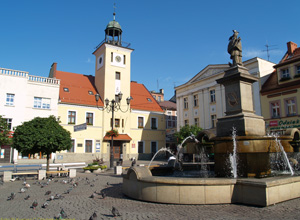
We invite you on a journey through the history of Rybnik.
Museum open:
Tuesday – Friday 9.00-16.00
Saturday – Sunday 10.00-16.00
Museum is closed on Mondays.
The exhibition takes the form of a unique journey through the mine tunnels.
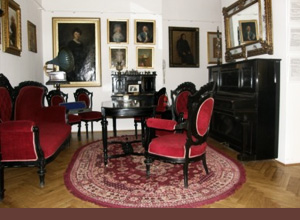
The exhibition takes the form of a unique historical tour of the streets of Rybnik at the turn of the 19th and 20th centuries.
The museum is a space where the city's history meets a modern approach to culture and education. It is a space where the past meets the present.
The city in the picture
Schlesischer Hof (Silesian Hotel) on the corner of Raciborska and Hallera Streets (formerly Schlachthofstrasse, Rzeźnicza Street, Juliana Marchlewskiego Street).
Dworcowa Street (Bahnhofstrasse, now Miejska Street, formerly Aleksandra Zawadzkiego Street) with the building of Paula Martiny's (later Władysław Malinowski's) building company, the parsonage and the church of the Evangelical-Augsburg parish.
A cinema (which changed its name between ’Pałac’ and ’Wanda’) run by Aleks Leutscher was located in Dworcowa Street. After the Second World War, it was transferred to the management of the Rybnik Machine Factory and operated under the name ’Górnik’.
Żorska Street (Sohrauerstrasse), view towards St. Anthony's Church.
At 17 Żorska Street, and subsequently Piłsudskiego Street, Ludwik Wróbel, a master tailor, ran a restaurant. He was a board member of the restaurateurs' union, secretary of the Union of Innkeepers, Hoteliers and Café Owners, a member of the Shooting Guild, a city councillor, a member of the board of the ‘Sokół’ Gymnastic Society, and a board member of the Association of Independent Polish Merchants.
Courtyard of the Rybnik Court (formerly a castle and the residence of the owners of Rybnik, as well as a Home for the Disabled) with a fountain and a lantern in the centre.
New Market Square (Neuer Ring, now Wolności Square) with a centrally located sedan well, the Helios cinema in the background on the left, and the silhouette of St. Anthony's Church in the distance on the right.
The oak trees planted in the square to commemorate the victory over France in 1871 began to wither during the First World War and were soon felled.
St. Anthony's Church (currently a basilica minor) in Rybnik, viewed from the south-west.
The church was damaged in June 1921 by an explosion of materials stored in railway wagons at the station. In 1957, the church tower was destroyed by fire.
County Office building in Rybnik.
Home to the county authorities, municipal authorities and, following administrative reform, the County Office in Rybnik.
Railway halt at Paruszowiec, built on an embankment ca. 1912, and the railway bridge over the River Ruda.
Church Square viewed from św. Jana Street with the parish church of Our Lady of Sorrows from 1801, designed by Franz Ilgner, and on the right, a now-defunct building with a shop.
Julius Hospital (also St. Julius, Juliuskrankenhaus) in Rybnik with the ‘Julius’ (1869) pavilions on the right and ‘Rafał’ (between 1887 and 1904) on the left, as well as the Chapel of St. Julius.
Raciborska Street at the intersection with Wodzisławska Street, early 20th century. On the left is the bakery of master baker Albert Mencel (Menzl), opposite is the Schlesische Hof (Silesian Hotel).
Local bakers and butchers came from a family that settled in Rybnik/Smolna in the 19th century.
Schlesischer Hof (Silesian Hotel) on the corner of Raciborska and Wodzisławska Streets with city panorama in the background.
Built in the first decade of the 20th century in an eclectic style, with rich Art Nouveau facade decorations, bay windows and gables. In 1923, a grenade was thrown into the hotel courtyard, shattering the windows, but fortunately, it was not enough to ignite the kerosene cart standing there. The hotel restaurant served Rybnik castle beer and beer from the Kissling and Haase breweries, as well as Märzen beer and Kulmbacher. From 1929 onwards, the building was owned by Piotr Kupczak, a colonial goods merchant who was killed by a bullet on 1 September 1939.
Schlesischer Hof (Silesian Hotel) on the corner of Raciborska and Hallera Streets (formerly Schlachthofstrasse, Rzeźnicza Street, Juliana Marchlewskiego Street).
Dworcowa Street (Bahnhofstrasse, now Miejska Street, formerly Aleksandra Zawadzkiego Street) with the building of Paula Martiny's (later Władysław Malinowski's) building company, the parsonage and the church of the Evangelical-Augsburg parish.
A cinema (which changed its name between ’Pałac’ and ’Wanda’) run by Aleks Leutscher was located in Dworcowa Street. After the Second World War, it was transferred to the management of the Rybnik Machine Factory and operated under the name ’Górnik’.
Żorska Street (Sohrauerstrasse), view towards St. Anthony's Church.
At 17 Żorska Street, and subsequently Piłsudskiego Street, Ludwik Wróbel, a master tailor, ran a restaurant. He was a board member of the restaurateurs' union, secretary of the Union of Innkeepers, Hoteliers and Café Owners, a member of the Shooting Guild, a city councillor, a member of the board of the ‘Sokół’ Gymnastic Society, and a board member of the Association of Independent Polish Merchants.
Courtyard of the Rybnik Court (formerly a castle and the residence of the owners of Rybnik, as well as a Home for the Disabled) with a fountain and a lantern in the centre.
New Market Square (Neuer Ring, now Wolności Square) with a centrally located sedan well, the Helios cinema in the background on the left, and the silhouette of St. Anthony's Church in the distance on the right.
The oak trees planted in the square to commemorate the victory over France in 1871 began to wither during the First World War and were soon felled.
St. Anthony's Church (currently a basilica minor) in Rybnik, viewed from the south-west.
The church was damaged in June 1921 by an explosion of materials stored in railway wagons at the station. In 1957, the church tower was destroyed by fire.
County Office building in Rybnik.
Home to the county authorities, municipal authorities and, following administrative reform, the County Office in Rybnik.
Railway halt at Paruszowiec, built on an embankment ca. 1912, and the railway bridge over the River Ruda.
Church Square viewed from św. Jana Street with the parish church of Our Lady of Sorrows from 1801, designed by Franz Ilgner, and on the right, a now-defunct building with a shop.
Julius Hospital (also St. Julius, Juliuskrankenhaus) in Rybnik with the ‘Julius’ (1869) pavilions on the right and ‘Rafał’ (between 1887 and 1904) on the left, as well as the Chapel of St. Julius.
Raciborska Street at the intersection with Wodzisławska Street, early 20th century. On the left is the bakery of master baker Albert Mencel (Menzl), opposite is the Schlesische Hof (Silesian Hotel).
Local bakers and butchers came from a family that settled in Rybnik/Smolna in the 19th century.
Schlesischer Hof (Silesian Hotel) on the corner of Raciborska and Wodzisławska Streets with city panorama in the background.
Built in the first decade of the 20th century in an eclectic style, with rich Art Nouveau facade decorations, bay windows and gables. In 1923, a grenade was thrown into the hotel courtyard, shattering the windows, but fortunately, it was not enough to ignite the kerosene cart standing there. The hotel restaurant served Rybnik castle beer and beer from the Kissling and Haase breweries, as well as Märzen beer and Kulmbacher. From 1929 onwards, the building was owned by Piotr Kupczak, a colonial goods merchant who was killed by a bullet on 1 September 1939.
The museum is implementing a project named BRIDGES OF CULTURE
co-financed by the European Regional Development Fund under the Interreg Czechia–Poland Programme covering the period 2021–2027 from the Small Projects Fund in the Silesia Euroregion.